Strategy
Fractional CMO vs. Fractional Chief AI Officer: Which One Does Your DTC Brand Actually Need?
If you had to hire one this quarter, would it be a Fractional CMO or a Fractional CAIO? A 3-question diagnostic to match your real constraint to the right role.
Jiri Nekovar · Fractional CMO and Chief AI Officer · 12 min read · 2026-05-03
If you had to pick one this quarter, which one moves the number? That is the only question worth answering. Most content on this topic will tell you "it depends on your situation" and then describe both roles in glowing terms without helping you make a decision. That is not what this post does. By the end of this, you will know exactly which hire fits your brand right now, or whether neither role is the right answer at all.
TL;DR / Key Takeaways
- A Fractional CMO fixes distribution problems: CAC is too high, conversion is too low, retention is leaking, or your team lacks strategic marketing direction.
- A Fractional CAIO fixes capability problems: your operations are slow, your team is AI-illiterate, your stack is unconnected, and you are leaving automation gains on the table.
- The diagnostic comes down to three questions about where your constraint actually lives.
- Fractional CMOs typically run $4,000–$8,000/month; Fractional CAIOs run $5,000–$12,000/month. Both are a fraction of the full-time alternative.
- Some operators offer both, but bundling is not the same as hiring two separate specialists. Understand what you are actually buying.
- There is a real scenario where neither role is the right answer, and I will tell you exactly when that is.
Why This Decision Matters Right Now
The fractional executive market grew 57% between 2023 and 2025, according to the Fractional Executive Industry Report 2025, driven primarily by demand from growth-stage companies that need C-suite expertise without C-suite cost structures. Inside that trend, two roles are dominating the conversation for DTC brands: the Fractional CMO (established, well-understood) and the Fractional CAIO (new, fast-growing, frequently misunderstood). Making the wrong call costs you more than the engagement fee. Hire a Fractional CMO when your real problem is operational AI debt, and you will get excellent strategy documents while your competitors automate. Hire a Fractional CAIO when your real problem is channel confusion and poor retention economics, and you will get impressive automation sitting on top of a broken funnel. The diagnostic matters more than the role itself.
The 3 Diagnostic Questions
Before looking at any role description or pricing table, answer these three questions honestly. They will tell you more than any comparison matrix.
Question 1: Is Your Problem Distribution or Capability?
Distribution problems look like this: your CAC is climbing quarter over quarter, your conversion rate is below 2% on paid traffic, your email-attributed revenue is under 20% of total (Klaviyo's 2025 benchmark puts healthy DTC brands at 25–35%), or your retention is soft and you cannot articulate a clear LTV improvement plan. These are marketing strategy and channel execution problems. Capability problems look like this: your team spends 15+ hours per week on tasks that should be automated, you have five tools that do not talk to each other, your support team is drowning in WISMO tickets, or you have no one internally who can evaluate whether a new AI tool is worth buying. These are AI literacy and systems architecture problems. Most brands have both. The question is which one is the binding constraint right now.
Question 2: Is Your Team Execution-Ready or Missing Direction?
A team that is execution-ready has clear channel owners, a defined content calendar, a working attribution model, and knows what to do on Monday morning. What they lack is the strategic layer: channel prioritization, budget allocation, creative direction, and someone who can tell them whether the plan is right. A team that is missing direction often shows up differently. They are busy but not productive. They are running campaigns without a clear thesis. They are adopting tools without a framework for evaluating them. If your team knows how to execute but the strategy is unclear, you need a CMO. If your strategy is clear but you are not extracting efficiency from AI and automation, you need a CAIO.
Question 3: Are You Optimizing the Existing Engine or Building a New One?
Optimization work (improving ROAS on existing channels, tightening email flows, fixing LTV:CAC ratios) is CMO territory. Building new systems (deploying agentic content production, setting up predictive churn models, building an AI-powered customer journey from scratch) is CAIO territory. If your engine is fundamentally broken, no amount of AI will fix it. If your engine is solid but running at 40% capacity because it is manual, that is an AI leadership problem.
Side-by-Side: Fractional CMO vs. Fractional CAIO
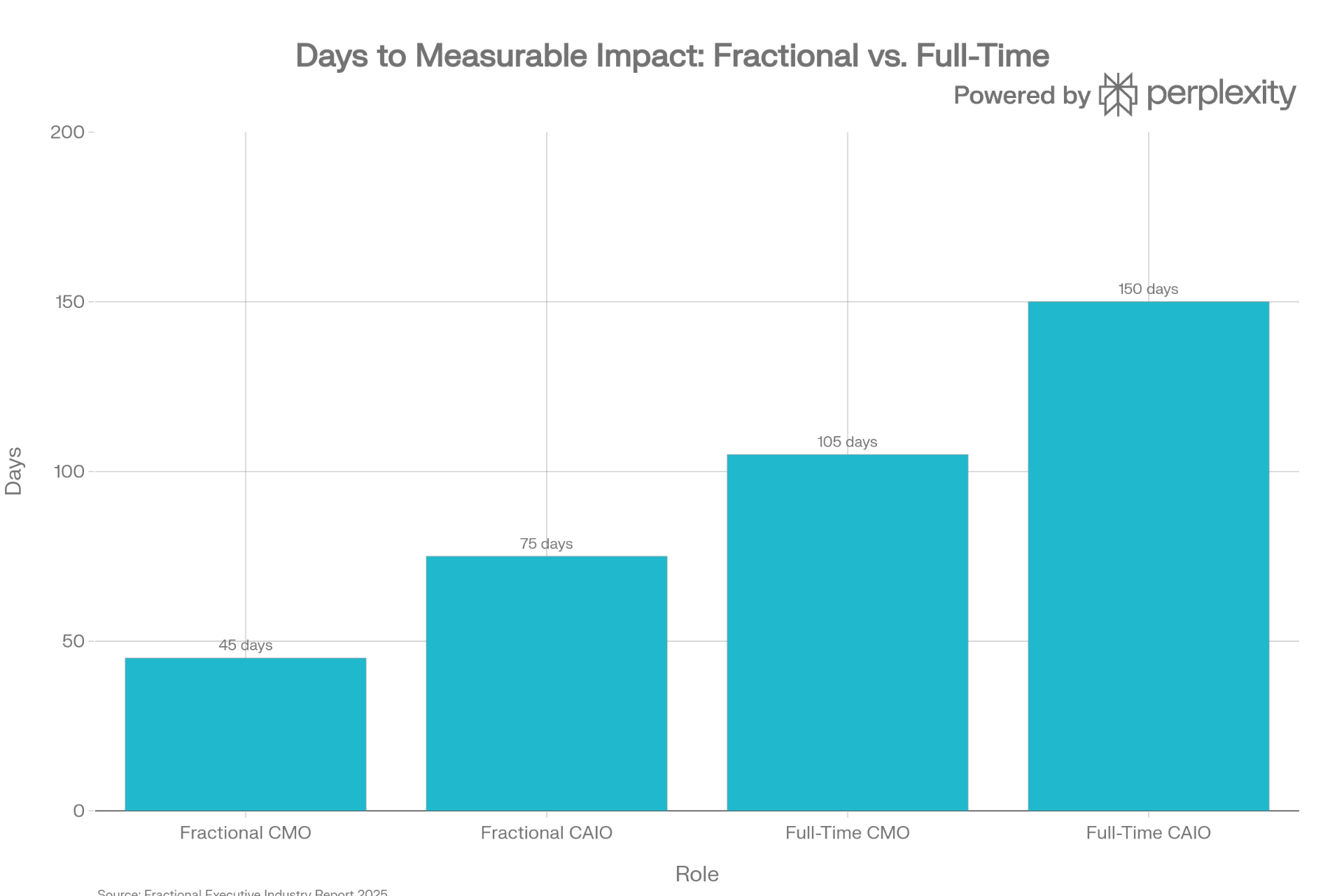
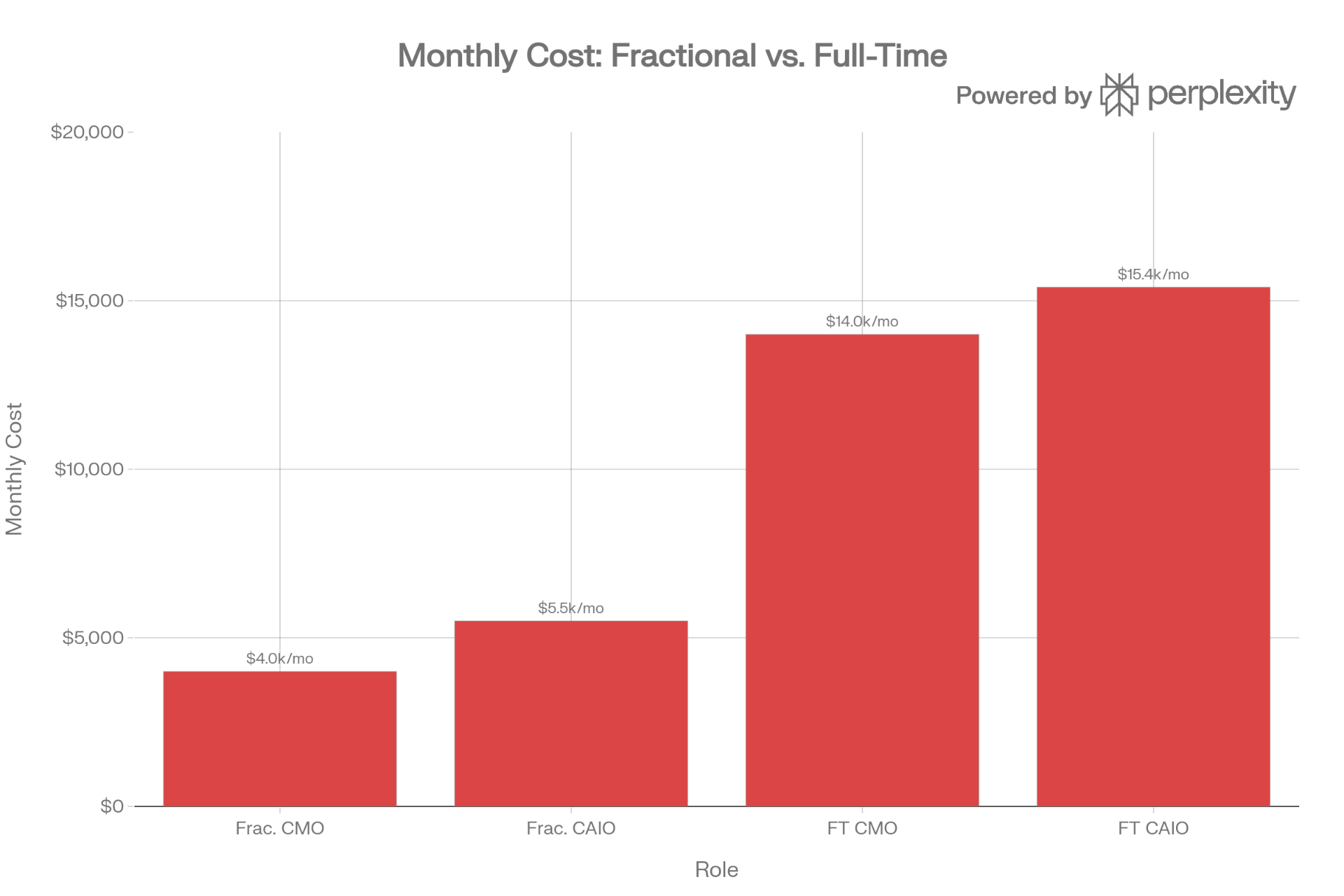
The Decision Framework: 3 Questions to One Answer
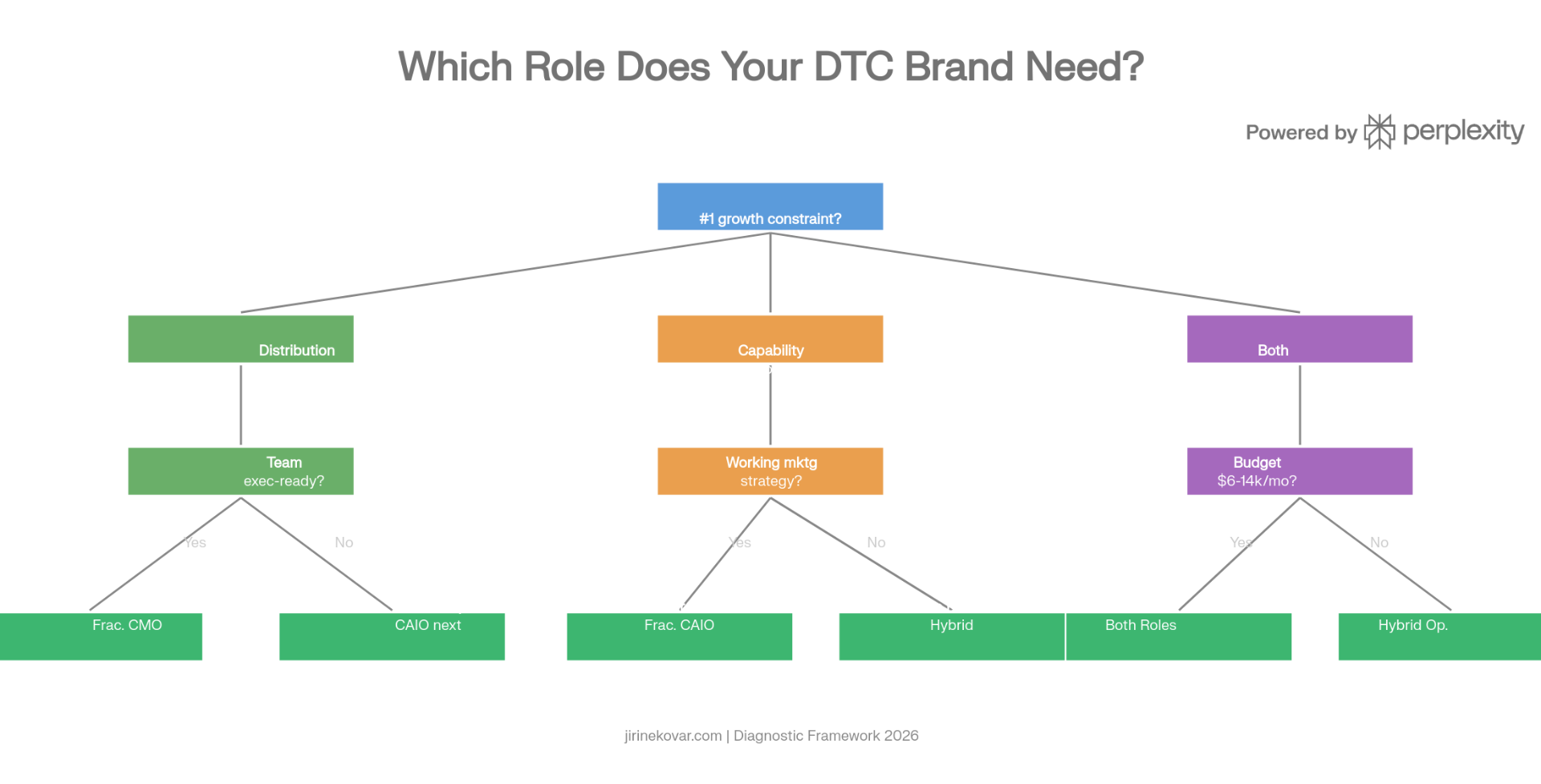 The flowchart above is the shortest path to a decision. But let me add context to the three outcomes.
Outcome 1: Hire a Fractional CMO
Your channels exist but underperform. You have a team but lack strategic leadership. Your CAC has increased more than 20% year-over-year (Meta's 2025 DTC benchmarks show average CPM on Facebook/Instagram increased 18% YoY, meaning everyone's CAC is under pressure). You need someone who can set the strategy, prioritize the channels, run the creative brief process, and hold the team accountable to KPIs. That is a CMO function.
Outcome 2: Hire a Fractional CAIO
Your marketing strategy is working. Revenue is growing. But your team is at capacity and adding headcount is not the answer. You have identified AI as the lever but lack the expertise internally to evaluate tools, build systems, or govern AI outputs. According to HubSpot's 2025 State of Marketing report, 64% of marketers say AI has already changed how they do their work, but only 21% feel their organization has a coherent AI strategy. That gap is exactly where a Fractional CAIO operates.
Outcome 3: Hire Both (or a Hybrid Operator)
Some founders at the $4M–$8M stage genuinely need both. The marketing strategy needs sharpening and the operational AI layer needs building simultaneously. In this case, a hybrid operator who holds both the CMO and CAIO functions can be more cost-efficient than two separate hires, as long as you understand the tradeoff. One person doing both means neither function gets full attention. It works when the brand needs direction and momentum more than deep specialization. I operate this way with several of my clients, and the key is being explicit upfront about which problem we are solving first. If your next decision is which AI workflow to build first, the AI Leverage Sprint defines the first three priorities and a 30-60-90-day plan before you commit to ongoing implementation.
When Neither Role Is the Right Answer
This section exists because I would rather lose a potential client to honesty than keep one through bad advice. You do not need a Fractional CMO if: You have not found product-market fit yet. If you are under $500K in revenue and still iterating on what you are selling and to whom, no marketing executive in the world is going to fix that. You need founders selling directly, not strategy decks. You do not need a Fractional CAIO if: You do not have clean data, a functional tech stack, or an internal team willing to maintain what gets built. AI systems need infrastructure to run on. Deploying automation on top of broken operations is a fast way to automate your mistakes at scale. Fix the foundation first. The real answer in both cases: Hire a good operator-level marketing manager or integrator, nail the fundamentals (product, offer, channel fit), and then bring in executive fractional leadership when the constraint shifts to strategy or systems.
A Real-World Scenario: Sports Supplement Brand at $3.8M
Hypothetical brand based on a composite of real client situations. Details altered for confidentiality. A sports supplement brand at $3.8M revenue came to me with what they thought was a CAIO problem. "We need AI to scale our content," the founder said on our first call. After 45 minutes of diagnostic questions, here is what I found:
- Email revenue was 14% of total revenue (well below the 25–35% Klaviyo benchmark for their category)
- There was no post-purchase retention sequence beyond a single "thank you" email
- Paid CAC had increased 31% in 12 months
- Their Klaviyo flows had not been touched in 14 months
- They had three different people "managing" paid ads with no clear channel lead This was not an AI problem. This was a marketing strategy and execution problem. The correct hire was a Fractional CMO to fix the channel economics, tighten the email infrastructure, and assign ownership to the paid channels. Once those fundamentals were working, the AI layer would compound on top of a system that actually converts. We agreed on a 90-day CMO engagement. By day 60, email revenue share was at 24%. CAC dropped 18% after consolidating paid channel ownership. The AI content production conversation is now on the roadmap for month four, and it will work because the funnel it feeds into is no longer broken. That is the sequence that matters: strategy first, AI second. Not because AI is less important, but because if you can't measure it, you shouldn't ship it, and you can't measure AI impact on top of a baseline that is fundamentally unclear.
A Fractional CMO owns marketing strategy, channel performance, and revenue growth direction. A Fractional Chief AI Officer owns the AI and automation layer: which systems to build, what tools to use, how to measure AI ROI, and how to reduce operational overhead through intelligent automation. The CMO makes sure you are growing in the right direction; the CAIO makes sure your operations scale without proportional headcount growth. Both report to the CEO, but they solve fundamentally different problems.
Can one person do both the CMO and CAIO role for a DTC brand?
Yes, under certain conditions. A hybrid fractional operator with deep experience in both marketing strategy and AI systems architecture can hold both functions effectively, especially for brands at the $2M–$6M range where full specialization in both roles is not yet justified. The tradeoff is depth; a hybrid operator will not go as deep on either function as a dedicated specialist would. The value is in getting strategic alignment between marketing and AI, which often breaks down when two separate operators are not communicating.
When should a Shopify DTC brand hire a Fractional CMO?
A Shopify DTC brand should hire a Fractional CMO when their CAC is increasing, revenue growth has stalled despite ad spend, the team lacks strategic marketing direction, or the brand is scaling past $1.5M–$2M and needs someone to own channel strategy. According to Shopify's Commerce Trends 2025 report, 61% of growing DTC brands cite "lack of marketing leadership clarity" as a top growth barrier. That is the exact gap a Fractional CMO closes.
When should a Shopify DTC brand hire a Fractional CAIO?
A Shopify DTC brand should hire a Fractional CAIO when marketing strategy is solid but execution is bottlenecked by manual operations, when the team spends more than 30% of their time on automatable tasks, or when the brand is at $3M+ and adding headcount is no longer the efficient way to scale output. The signal is usually a combination of rising labor costs, inconsistent content production, and a support team drowning in repetitive tickets.
How much does a Fractional CMO cost compared to a Fractional CAIO?
Fractional CMOs typically charge $4,000–$8,000 per month for 4–12 hours per week. Fractional CAIOs run slightly higher at $5,000–$12,000 per month due to the technical implementation component of the role. Both are dramatically less expensive than their full-time equivalents: a full-time CMO averages $140,000–$175,000 base salary, while a full-time CAIO averages $150,000–$185,000, according to Radford and Levels.fyi 2025 compensation data.
Is there a situation where a brand needs neither a Fractional CMO nor a Fractional CAIO?
Yes, and it is more common than most fractional executives will admit. Brands under $500K that have not yet found product-market fit do not need either role. Brands with broken operations and no internal team capable of executing on strategy or maintaining deployed systems are not ready for either hire. In both cases, the right move is to nail the operational and product fundamentals first, then bring in executive-level fractional leadership when the constraint shifts to strategy or systems.
What should I look for when vetting a Fractional CMO or Fractional CAIO for my brand?
For a Fractional CMO, look for documented revenue impact at brands in your category and revenue range, channel-specific expertise relevant to your growth stage (paid social, email, SEO), and the ability to define KPIs and hold themselves accountable to them. For a Fractional CAIO, look for evidence of deployed systems (not just recommendations), comfort with your existing tech stack (Shopify, Klaviyo, Meta), and a framework for measuring ROI before anything gets built. In both cases, anyone who cannot give you specific before-and-after numbers from previous engagements is not the right hire.
Conclusion
The answer is not "hire both and figure it out." The answer is to diagnose your actual constraint, match the role to the problem, and move fast enough that the decision is worth making. If your CAC is broken, email is underperforming, or your team is executing without a strategic north star, start with a Fractional CMO. If your strategy is working but your operations are drowning in manual work and your competitors are automating, start with a Fractional CAIO. If you are not sure, spend 30 minutes with me. I will tell you which role you actually need, including if that role is neither. No pitch, no pressure, just a direct answer.
Sources cited: HubSpot State of Marketing Report 2025; Klaviyo E-Commerce Benchmarks 2025; Shopify Commerce Trends 2025; Meta Business Performance Benchmarks 2025; Radford and Levels.fyi Executive Compensation Data 2025; Fractional Executive Industry Report 2025.