Strategy
What is a Fractional Chief AI Officer? A Complete Guide for DTC e-commerce Brands in 2026
A senior AI executive who embeds part-time to own AI strategy, ROI, and implementation for DTC brands at $2M-$10M. Full pricing, scope, and a 90-day framework.
Jiri Nekovar · Fractional CMO and Chief AI Officer · 11 min read · 2026-05-03
A Fractional Chief AI Officer (Fractional CAIO) is a senior AI executive who embeds into a company on a part-time, contract basis to own AI strategy, implementation, and ROI accountability, without the cost or commitment of a full-time hire.
TL;DR / Key Takeaways
- The CAIO role category grew 70% year-over-year in 2025, making it one of the fastest-growing C-suite titles on record.
- Compare the scope, implementation ownership, and total cost of each option. Part-time advisory and a full-time executive are different purchases.
- Compare the monthly fee, committed term and implementation budget. The AI Leverage Sprint is a separate diagnostic that helps define the work before an ongoing engagement.
- A Fractional CAIO owns concrete initiatives: agentic content production, AI-powered customer journeys, predictive churn modeling, automated outbound, and AI support triage.
- The ROI case is direct. According to McKinsey's 2025 State of AI report, brands that systematically embed AI into their marketing stack see 15–40% improvements in marketing efficiency within the first year.
- This role is not about buying tools. It is about building a system that compounds. A Fractional CAIO is the person who makes sure "if you can't measure it, you shouldn't ship it" is actually enforced.
Why This Role Exists in 2026
Seventy-three percent of DTC brands surveyed by Shopify in 2025 said AI was a "high priority" for their marketing stack. Fewer than 18% had anyone internally accountable for AI outcomes. That gap is the exact reason the Fractional CAIO category exploded. The problem is structural. A $5M Shopify brand cannot afford a $175K full-time AI executive, a team of AI engineers, and a six-month ramp time. But they also cannot afford to let their competitors automate while they are still writing product descriptions by hand and doing manual email segmentation. The fractional model closes that gap. It gives growing brands access to senior-level AI leadership at a cost that is actually aligned with their stage.
What Does a Fractional Chief AI Officer Actually Do?
This is where most explainers get fuzzy. Let me be specific.
Agentic Content Production
A Fractional CAIO designs and deploys autonomous systems that produce marketing content at scale. For a Shopify brand, this means building pipelines that take a product SKU and output a suite of short-form videos, ad copy, email sequences, and SEO-optimized product descriptions without a human touching each one. According to HubSpot's 2025 State of Marketing Report, marketers using AI content workflows publish 3x more content while reducing per-asset production costs by up to 60%.
AI-Powered Customer Journey
This is not "add a chatbot to your site." A properly designed AI customer journey maps every touchpoint from first ad click to repeat purchase and automates the intelligence layer. That means personalized post-purchase flows triggered by purchase history, dynamic email segmentation that updates in real time, and browse-abandonment sequences that adapt to product category. Klaviyo's 2025 e-commerce benchmark data shows that brands using dynamic AI segmentation generate 29% higher revenue per recipient compared to static list sends.
AI Agents for Support Triage
For a $5M brand processing 200–500 weekly support tickets, this is table stakes. An AI support triage agent routes tickets, drafts responses, handles WISMO (where is my order) queries automatically, and escalates only the complex cases to a human. Gartner forecasts that by end of 2026, 80% of customer service interactions at mid-market brands will involve an AI agent at some layer of the flow.
Predictive Churn Modeling
For subscription-based DTC brands in health, wellness, and food, churn is the number that kills everything. A Fractional CAIO builds models that score subscribers by churn probability and trigger automated retention campaigns before the cancel happens. The brands I work with that run predictive churn models see 15–25% improvement in net revenue retention within 90 days of deployment.
Automated Outbound
This is relevant for brands running B2B wholesale or partnership channels. Automated outbound systems use enriched data from tools like Clay, personalization via AI video and voice, and multi-step sequences via Lemlist or similar platforms. The result is a pipeline that runs continuously without a sales rep manually doing anything except taking calls.
Fractional CMO vs. Fractional CAIO vs. Full-Time CAIO
These roles are related but distinct. Here is how they stack up across the dimensions that matter for a $2–10M DTC brand. The honest answer for most brands reading this: you need both a Fractional CMO and a Fractional CAIO at some point. Or you need one person who does both, which is the model I operate under at marsmars.
The Real Cost Picture
Compare a written fractional proposal with the fully loaded cost of the hire you are considering. Include the monthly fee, minimum term, internal execution capacity, software and any separately scoped implementation. An advisory engagement and an embedded operator are different purchases.
For illustration, a proposal at $4,000 per month annualizes to $48,000; one at $8,000 annualizes to $96,000. These are arithmetic examples, not current quotes or market averages. A fixed savings percentage would require a comparable full-time budget and equivalent scope.
The AI Leverage Sprint is a separate three-week diagnostic for founders who need to decide what to build first. It produces the priorities and implementation plan; your team can implement them or discuss follow-on support. Check the current offer and a written proposal for pricing and terms.
CAIO Adoption Rates: Where the Market Is Moving
The CAIO role barely existed in 2022. By 2024 it was a conversation in boardrooms. By 2026 it is table stakes for any growth-stage brand that takes AI seriously.
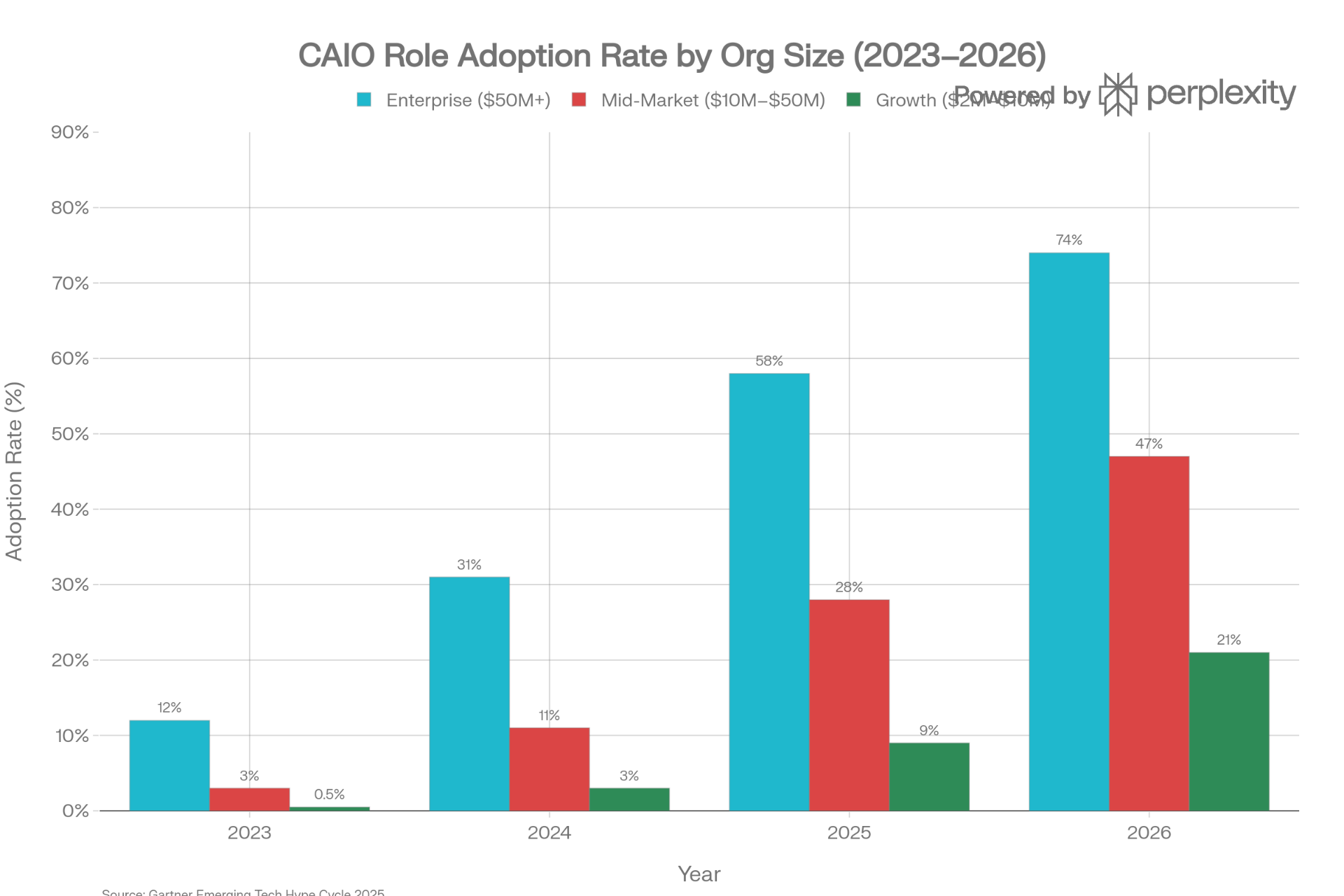 According to Gartner's 2025 Emerging Technology Hype Cycle, AI governance and AI leadership roles are entering the "slope of enlightenment," meaning the market has moved past hype and into practical adoption. For DTC brands at the $2M–$10M level, the window to adopt early and build an AI-compounding advantage is right now, roughly 2025–2027, before it becomes a baseline expectation.
The Fractional CAIO Framework: How I Run It
When I embed as a Fractional CAIO with a Shopify DTC brand, here is the structure I follow across the first 90 days.
Week 1–2: Audit and Baseline
- Map every tool in the current stack (ESP, CRM, ad platforms, support, analytics)
- Identify where human time is being spent on tasks that could be automated
- Pull LTV, CAC, churn rate, ROAS, and email revenue share as baseline metrics
- Flag the 2–3 biggest AI opportunities ranked by revenue impact vs. implementation effort
Week 3–4: Architecture and Prioritization
- Design the AI stack architecture (what tools, what integrations, what data flows)
- Select the first 2 initiatives to build: always one quick win (under 2 weeks to ship) and one structural build (4–8 weeks)
- Define the measurement framework. If you can't measure it, you shouldn't ship it.
Month 2–3: Build, Deploy, Measure
- Oversee or directly build the first agentic systems
- Run A/B tests against pre-AI baselines
- Report weekly on KPIs tied to each initiative
- Train internal team members to maintain what gets deployed
Month 3+: Compound
- Stack each new initiative on top of the last
- Begin predictive modeling work once enough behavioral data is available
- Identify the next highest-leverage AI initiative from the audit list
Real-World Example: Health Supplement Brand, $4.2M Revenue
Note: The brand name has been anonymized at the client's request. The numbers are real. This brand was running a Shopify Plus store selling subscription supplements. Their churn rate was 11% monthly. Their email revenue share was 18% of total revenue (benchmark for their category should be 25–35%, per Klaviyo 2025 data). Their support team was handling 400+ tickets per week, 70% of which were WISMO queries. What we built in 90 days:
- AI support triage agent that resolved 68% of WISMO queries without a human touch, reducing ticket volume by 270+ per week
- Predictive churn model integrated with their Klaviyo instance, triggering a 3-step retention sequence for subscribers with churn probability above 40%
- Agentic content pipeline producing 12 short-form video assets per week for paid social, replacing what had been a 3-day manual production process Results after 90 days:
- Monthly churn dropped from 11% to 7.4% (a 32.7% relative improvement)
- Email revenue share increased from 18% to 26%
- Content production cost per asset reduced by 58%
- Support team headcount needs reduced, one part-time contractor removed from the roster That is what a Fractional CAIO engagement looks like when it is run with measurement discipline from day one.
A Fractional Chief AI Officer is a part-time AI executive who owns a company's artificial intelligence strategy, tool stack, automation roadmap, and ROI accountability on a contract basis. They function like a full-time CAIO but work across multiple companies simultaneously, making the role financially viable for growth-stage brands that cannot justify a $175K+ full-time hire. The role covers everything from selecting and integrating AI tools to building autonomous systems that reduce manual workload and increase revenue.
How much does a Fractional Chief AI Officer cost?
Pricing depends on the scope, time commitment and responsibility for implementation. Ask for the monthly fee, minimum term, included deliverables and costs your team still owns. Multiply the monthly fee by the planned duration to compare budgets; do not assume a fixed percentage saving against a full-time hire. The AI Leverage Sprint is a separately priced diagnostic, with its current scope and price on the Sprint page.
Is a Fractional CAIO the same as a Fractional CTO?
No. A Fractional CTO owns software architecture, engineering teams, and product development. A Fractional CAIO owns the AI strategy layer: which AI tools to use, how to integrate them into business operations, how to measure their ROI, and how to build autonomous systems that generate revenue or reduce cost. The roles can overlap, especially at smaller companies, but they are distinct in focus and output.
What AI initiatives should a Fractional CAIO prioritize for a Shopify brand?
The highest-impact initiatives for most $2M–$10M Shopify brands are: (1) AI support triage to reduce manual ticket volume, (2) predictive churn modeling for subscription retention, (3) agentic content production for paid social and email, (4) dynamic customer segmentation in Klaviyo or similar, and (5) automated outbound if the brand runs a B2B or wholesale channel. The right sequence depends on where the brand is bleeding the most time or margin right now.
When does a DTC brand actually need a Fractional CAIO vs. a Fractional CMO?
A Fractional CMO is right when the brand needs marketing strategy, channel clarity, and team leadership. A Fractional CAIO is right when the brand has its marketing direction figured out but needs AI systems to scale execution without adding headcount. Many brands at the $3M–$8M stage benefit from both, or from one person who operates across both domains. If your current bottleneck is "we know what to do but can't execute fast enough," that is a CAIO problem.
How do you measure ROI from a Fractional CAIO engagement?
Every CAIO engagement should define 3–5 KPIs before any build starts. Typical metrics include: monthly churn rate, email revenue share, cost per content asset, support ticket deflection rate, and ROAS on AI-assisted ad creative. Each initiative should have a pre-deployment baseline and a 30/60/90-day measurement cadence. If an initiative cannot be measured, it should not be built. That is a non-negotiable operating principle.
How is a Fractional CAIO different from an AI consultant?
An AI consultant delivers a recommendation and leaves. A Fractional CAIO stays, builds, measures, and iterates. The consulting model produces slide decks and roadmaps; the fractional executive model produces deployed systems with measurable results. For a growth-stage DTC brand, the fractional model is almost always more valuable because the output is operational capability, not advisory documentation.
Conclusion
The brands that are going to dominate their categories in 2027 are not the ones with the biggest ad budgets. They are the ones that built compounding AI systems in 2025 and 2026 while everyone else was still debating whether AI was real. A Fractional CAIO is how a $2M–$10M DTC brand accesses that capability without a $200K salary commitment and a six-month ramp. If you are running a Shopify brand in health, wellness, sports, fashion, or subscriptions and you are ready to actually build the AI layer into your business, let's talk. I run 30-minute strategy calls where we identify your highest-leverage AI opportunity and what it would take to build it.
Sources cited: McKinsey State of AI 2025; HubSpot State of Marketing Report 2025; Klaviyo E-Commerce Benchmarks 2025; Shopify Commerce Trends 2025; Gartner Emerging Technology Hype Cycle 2025; Levels.fyi and Radford CAIO compensation data 2025.